
In industrial manufacturing, consistency is everything. Whether you’re producing corrugated boxes, coated abrasives, paints, paper tubes, or mining chemicals, even minor variations in raw material performance can affect product quality, machine efficiency, and production costs.
This is especially true when working with starch-based adhesives, binders, and specialty formulations. While several factors influence performance, two parameters often determine how reliably a starch product performs on the production floor: viscosity and pH.
These are not just laboratory measurements. They directly influence how a starch solution flows, bonds, dries, and behaves during manufacturing. Understanding their importance can help manufacturers reduce process variations, improve output quality, and achieve more consistent results.
What Is Viscosity and Why Does It Matter?
Viscosity refers to the thickness or flow behaviour of a liquid. In industrial starch applications, it determines how easily an adhesive, binder, or coating can be applied and how it performs during production.
Think of viscosity as the balance between a product being too thick and too thin. If that balance is not right, it can create several operational challenges.
Why Viscosity Is Important?
A properly controlled viscosity helps:
- Ensure smooth application during processing
- Improve adhesive spread and penetration
- Deliver consistent bond strength
- Support uniform coating performance
- Reduce machine stoppages and material wastage
- Improve overall production efficiency
When viscosity is too high, adhesives may become difficult to pump, spread, or apply evenly. On the other hand, if viscosity is too low, the material may fail to provide the required bonding strength or coating performance.
For manufacturers, maintaining the right viscosity often means achieving a more stable production process with fewer quality issues.
How Different Industries Depend on Viscosity
Every industry has unique processing requirements, but viscosity remains a critical performance factor across applications.
| Industry | Why Viscosity Matters |
| Corrugated Boxes | Helps achieve uniform adhesive application and stronger bonding |
| Coated Abrasives | Supports even binder distribution across abrasive grains |
| Paint Manufacturing | Maintains coating consistency and application quality |
| Paper Tubes & Cores | Improves adhesive penetration and bond formation |
| Mining | Contributes to stable and predictable processing performance |
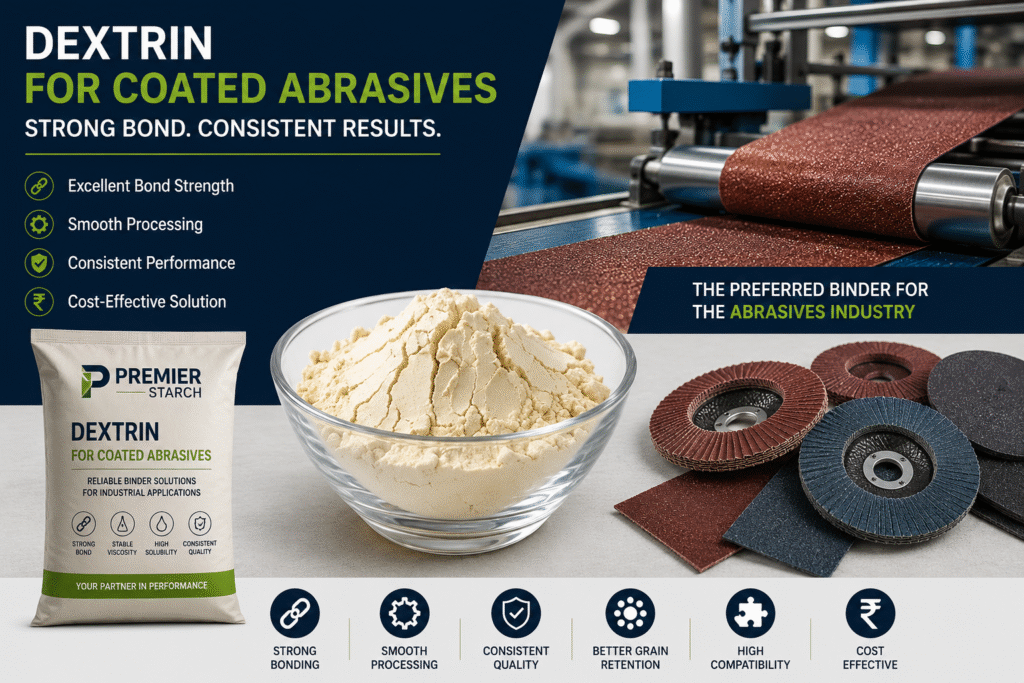
For example, manufacturers using dextrin for coated abrasives require consistent viscosity to ensure uniform coating and reliable product quality. Even small variations can affect the final performance of the abrasive material.
Understanding pH in Industrial Starch Formulations
While viscosity often receives the most attention, pH plays an equally important role.
pH measures the acidity or alkalinity of a starch solution. Maintaining the correct pH helps preserve product stability and ensures the starch performs as intended throughout storage and application.
A starch product may have the right viscosity when produced, but if pH is not controlled, its performance can change over time.
Benefits of Proper pH Control
Maintaining an appropriate pH helps:
- Improve product stability
- Prevent premature degradation
- Support consistent viscosity retention
- Enhance compatibility with additives
- Extend storage life
- Reduce processing variations
When pH moves outside the desired range, manufacturers may experience inconsistent performance, reduced bond strength, or changes in product behaviour during production.
Why Viscosity and pH Must Be Controlled Together?
Viscosity and pH are closely connected. A change in pH can influence the structure of starch molecules, which can then alter viscosity and overall product performance.
This is why experienced manufacturers monitor both parameters throughout the production process.
Common Problems Caused by Poor Control
| Production Issue | Possible Cause |
| Weak bonding performance | Unstable viscosity or pH |
| Uneven coating quality | Viscosity fluctuations |
| Reduced shelf life | Improper pH levels |
| Application difficulties | Excessively high viscosity |
| Batch-to-batch inconsistency | Variations in pH and viscosity |
Maintaining tight control over both factors helps ensure products perform consistently from one batch to the next.
The Importance of Quality Testing
Industrial manufacturers cannot afford uncertainty in their raw materials. A small variation in starch performance can impact large-scale production runs and lead to unnecessary costs.
This is why comprehensive quality testing is essential.
Typical quality checks include:
- Viscosity testing using Brookfield viscometers
- Flow analysis
- Moisture testing
- Solubility evaluation
- pH analysis
- Application-specific performance validation
Regular testing helps manufacturers identify variations before products reach the customer, ensuring greater consistency and reliability.
Different Applications Require Different Performance Characteristics
There is no single viscosity or pH specification that suits every industry. Requirements vary depending on the application.
Corrugation Industry
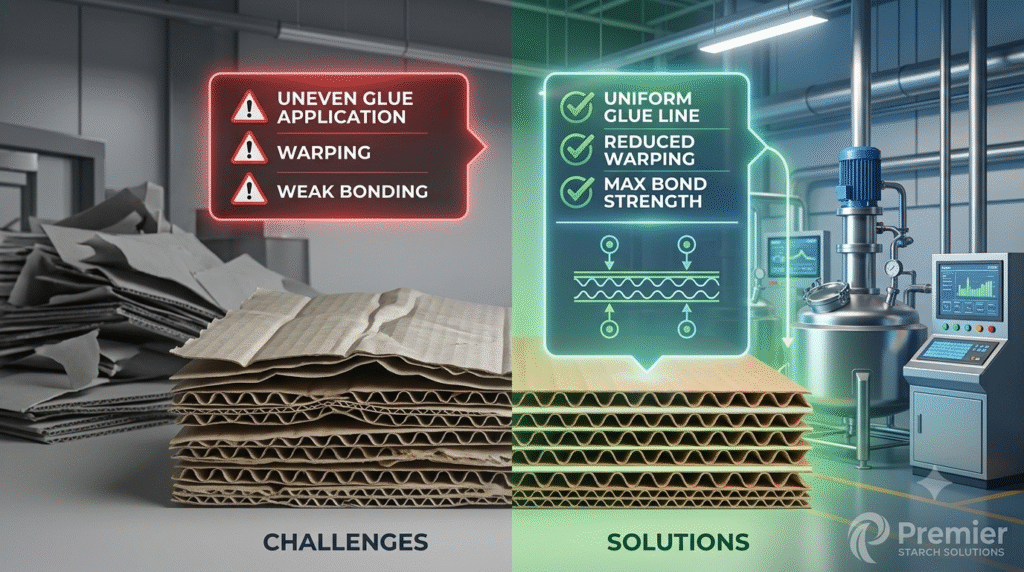
Corrugated box manufacturers need adhesives that offer smooth application, quick bonding, and dependable performance on production lines. Products such as Stargel® 5060 Cold Pasting Gum Powder are developed to support these requirements.
Paint Manufacturing
In paint formulations, maintaining the right viscosity is essential for coating uniformity and product stability. Stardex® 2155-AP SPL is designed to meet the specific demands of paint manufacturing applications.
Paper Tube and Core Manufacturing
Paper tube manufacturers require adhesives that provide strong bonding while supporting efficient production speeds. Stardex® 2155-H and Stardex® 2155-Tube are formulated to deliver consistent performance in these applications.
Mining Applications
Mining processes often require starch-based products with stable handling and predictable performance characteristics. Stardex® 2155-Mining is developed to support these specialised industrial requirements.
Choosing the Right Starch Supplier
When selecting a supplier, manufacturers should look beyond pricing alone. Consistency, technical expertise, and quality control capabilities often have a greater impact on long-term production performance.
A reliable modified starch manufacturer should provide:
- In-house research and development support
- Batch-wise quality control
- Technical guidance for industrial applications
- Consistent product specifications
- Comprehensive technical documentation
- Reliable manufacturing and supply capabilities
These factors help ensure products perform consistently under real operating conditions.
Conclusion
In industrial starch applications, viscosity and pH are much more than quality control numbers on a test report. They influence how a product flows, bonds, performs, and ultimately contributes to manufacturing efficiency.
Whether the application involves corrugation, paints, coated abrasives, paper tubes, or mining, maintaining the right balance of viscosity and pH helps improve product consistency, reduce operational challenges, and support better production outcomes.
Manufacturers that prioritise these parameters often achieve greater process stability, improved product quality, and more reliable results across every stage of production.
Partnering with Experience That Understands Industrial Performance
For over three decades, Premier Starch has been supplying performance-driven starch derivatives, dextrins, and adhesive solutions to industries that demand consistency. Backed by dedicated R&D facilities, stringent quality testing, and application-focused expertise, Premier Starch works closely with manufacturers to develop solutions that fit real production environments not just laboratory specifications.