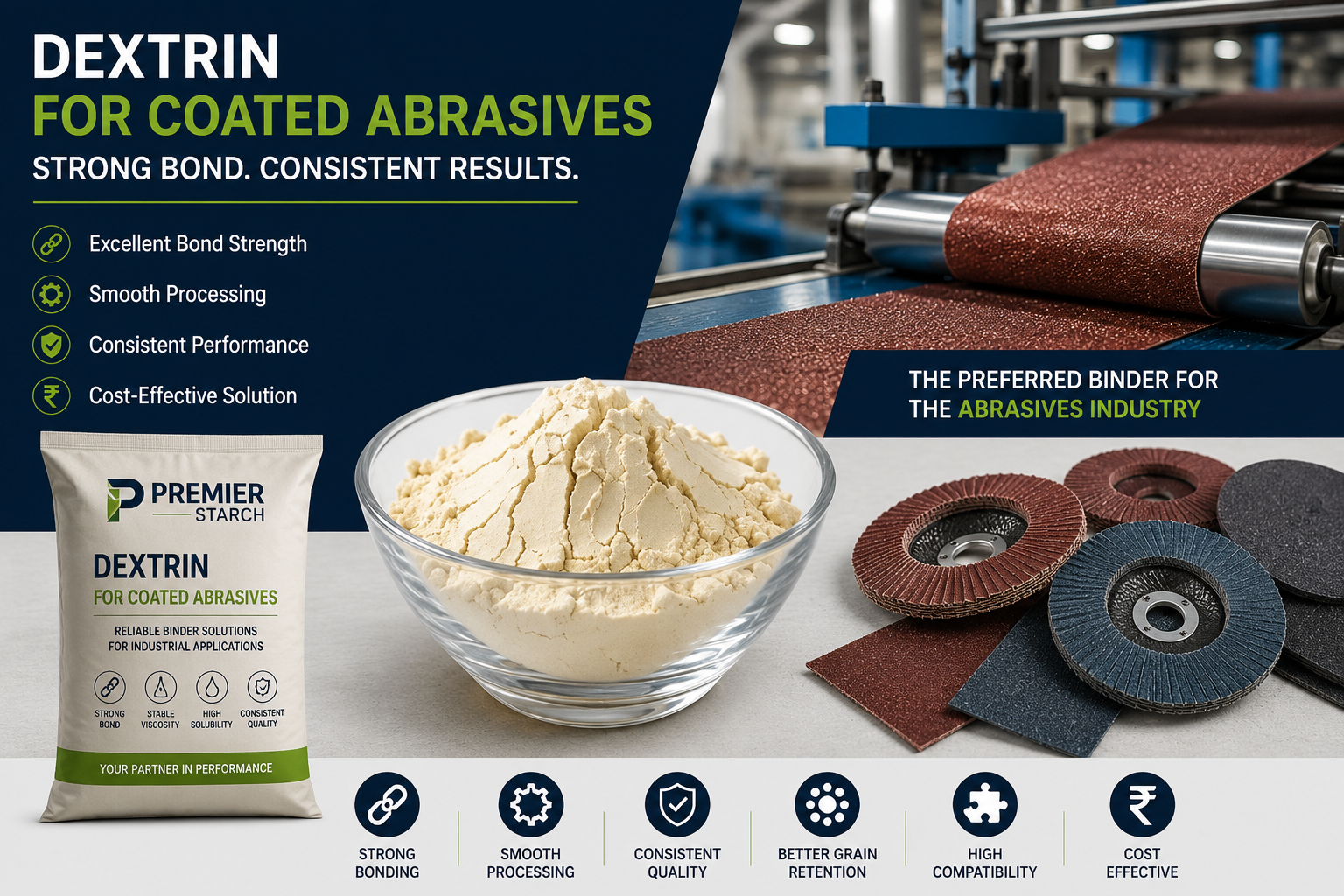
The coated abrasives industry demands precision at every stage of manufacturing. Whether producing abrasive belts, sanding discs, sheets, or rolls, the quality of the binder directly impacts product performance, durability, and production efficiency. This is why dextrin for coated abrasives has remained one of the most trusted binder solutions for manufacturers across the industry.
Natural dextrin offers excellent bonding strength, reliable processing characteristics, and consistent performance while supporting cost-effective manufacturing. As production requirements continue to evolve, manufacturers increasingly seek binders that provide both dependable quality and scalability without compromising operational efficiency.
In this article, we explore why dextrin continues to be the preferred choice for coated abrasives manufacturing and what factors should be considered when selecting the right grade.
Understanding the Role of Dextrin in Coated Abrasives
Coated abrasives are manufactured by bonding abrasive grains such as aluminium oxide, silicon carbide, or zirconia onto flexible backings including paper, cloth, fibre, or film. The binder plays a critical role in securing these abrasive grains and maintaining their position throughout the product’s service life.
A high-quality dextrin for coated abrasives provides the necessary adhesion required during manufacturing while ensuring excellent compatibility with subsequent resin systems used in the curing process.
Its primary functions include:
- Strong initial bonding of abrasive grains
- Uniform coating across the substrate
- Stable viscosity during production
- Improved processing efficiency
- Reliable compatibility with resin-based top coats
- Consistent product quality across production batches
These characteristics make dextrin an essential ingredient in modern coated abrasives manufacturing.
Why Manufacturers Prefer Dextrin for Coated Abrasives
Choosing the right binder influences not only product quality but also manufacturing efficiency and production costs. Below are the major reasons why dextrin remains a preferred industrial binder.
1. Excellent Initial Bond Strength
The primary purpose of a binder is to securely hold abrasive grains before the final resin curing stage. Dextrin provides excellent green strength, ensuring that abrasive particles remain evenly distributed throughout processing.
This results in:
- Better grain retention
- Reduced particle loss
- Improved coating consistency
- Higher finished product quality
2. Smooth Processing During Manufacturing
Manufacturing coated abrasives involves continuous coating operations where consistency is critical.
Dextrin offers:
- Stable flow properties
- Easy application
- Uniform spreading
- Reduced process interruptions
These processing advantages contribute to improved productivity and reduced material wastage.
3. Consistent Batch-to-Batch Performance
Production lines require raw materials that perform consistently over time.
A quality dextrin for abrasives industry should deliver:
| Manufacturing Requirement | Benefit of Quality Dextrin |
| Uniform viscosity | Stable coating performance |
| Controlled moisture | Better storage stability |
| Consistent solubility | Reliable production results |
| Repeatable quality | Reduced manufacturing variation |
Consistent raw materials ultimately help manufacturers minimise rejects and maintain product quality.
4. Better Compatibility with Industrial Resin Systems
Coated abrasive production commonly involves resin systems during later manufacturing stages. Dextrin works effectively as an intermediate binder and integrates well within these production processes.
This compatibility helps manufacturers achieve:
- Reliable coating adhesion
- Strong abrasive grain retention
- Improved product durability
- Efficient curing performance
5. Cost-Effective Manufacturing
Manufacturers constantly look for opportunities to improve productivity without increasing production costs.
Dextrin offers an excellent balance of:
- Performance
- Availability
- Processing efficiency
- Competitive pricing
For high-volume production facilities, these advantages translate into lower operational costs while maintaining consistent product quality.
Characteristics to Look for When Selecting Dextrin
Not every dextrin grade is suitable for coated abrasives. Manufacturers should evaluate products based on technical performance rather than price alone.
Important selection criteria include:
- Stable viscosity
- Controlled moisture content
- Consistent particle size
- Excellent solubility
- Reliable bonding performance
- Batch-to-batch consistency
- Technical support from the manufacturer
Choosing the right supplier ensures long-term manufacturing stability and dependable product performance.
Applications of Dextrin in the Abrasives Industry
Dextrin is widely used across various coated abrasive products, including:
- Sanding sheets
- Sanding discs
- Abrasive rolls
- Abrasive belts
- Flexible abrasive products
- Industrial polishing materials
Its versatility makes it suitable for manufacturers serving woodworking, metal fabrication, automotive, construction, and engineering industries.
Why Product Consistency Matters
For abrasive manufacturers, even minor variations in binder quality can affect production efficiency and finished product performance.
A dependable supplier should provide:
- Standardised manufacturing processes
- Batch-wise quality control
- Reliable technical documentation
- Consistent product availability
- Technical assistance for plant trials
These factors reduce production risks and support long-term manufacturing consistency.
Choosing the Right Dextrin Supplier
When evaluating suppliers, manufacturers should look beyond pricing. A reliable partner offers technical expertise, quality assurance, and dependable supply capabilities.
Consider the following factors before selecting a supplier:
| Evaluation Factor | Why It Matters |
| Manufacturing experience | Better understanding of industrial applications |
| In-house quality testing | Consistent product quality |
| Technical support | Assistance during production trials |
| Reliable supply chain | Uninterrupted manufacturing |
| Product scalability | Supports increasing production requirements |
Working with an experienced manufacturer helps maintain consistent product performance while supporting future production growth.
A Proven Solution for Coated Abrasives Manufacturers
For manufacturers seeking a reliable binder solution, Stardex® 2155 GNL has been developed specifically for coated abrasives applications. It offers consistent bonding performance, dependable processing characteristics, competitive pricing, and production scalability, making it well suited for manufacturers looking to optimise quality while supporting growing production demands.
Conclusion
The continued demand for dextrin for coated abrasives reflects its proven ability to deliver reliable bonding performance, efficient processing, and consistent manufacturing results. From securing abrasive grains to improving production efficiency, dextrin remains one of the most dependable binder solutions for the abrasives industry.
As manufacturers focus on quality, cost optimisation, and scalable production, selecting the right dextrin grade becomes an important decision that directly impacts product performance and operational efficiency.
Why Choose Premier Starch for Industrial Dextrin Solutions?
With over 35 years of experience in manufacturing speciality starch products, Premier Starch Products Pvt. Ltd. supplies performance-driven dextrin solutions trusted across multiple industrial sectors. Every product is backed by in-house R&D, stringent quality testing, and application-focused technical support to help manufacturers achieve reliable and repeatable results. Whether you require standard grades or application-specific solutions, Premier Starch delivers consistent quality, dependable supply, and expertise that supports long-term manufacturing success.