The food industry is constantly evolving to meet changing consumer expectations for quality, consistency, convenience, and longer shelf life. From ready-to-eat meals and dairy products to sauces and frozen foods, manufacturers need ingredients that can withstand demanding processing conditions while maintaining the desired texture and stability of the final product. One ingredient that continues to play a significant role in achieving these goals is E1422 modified starch.
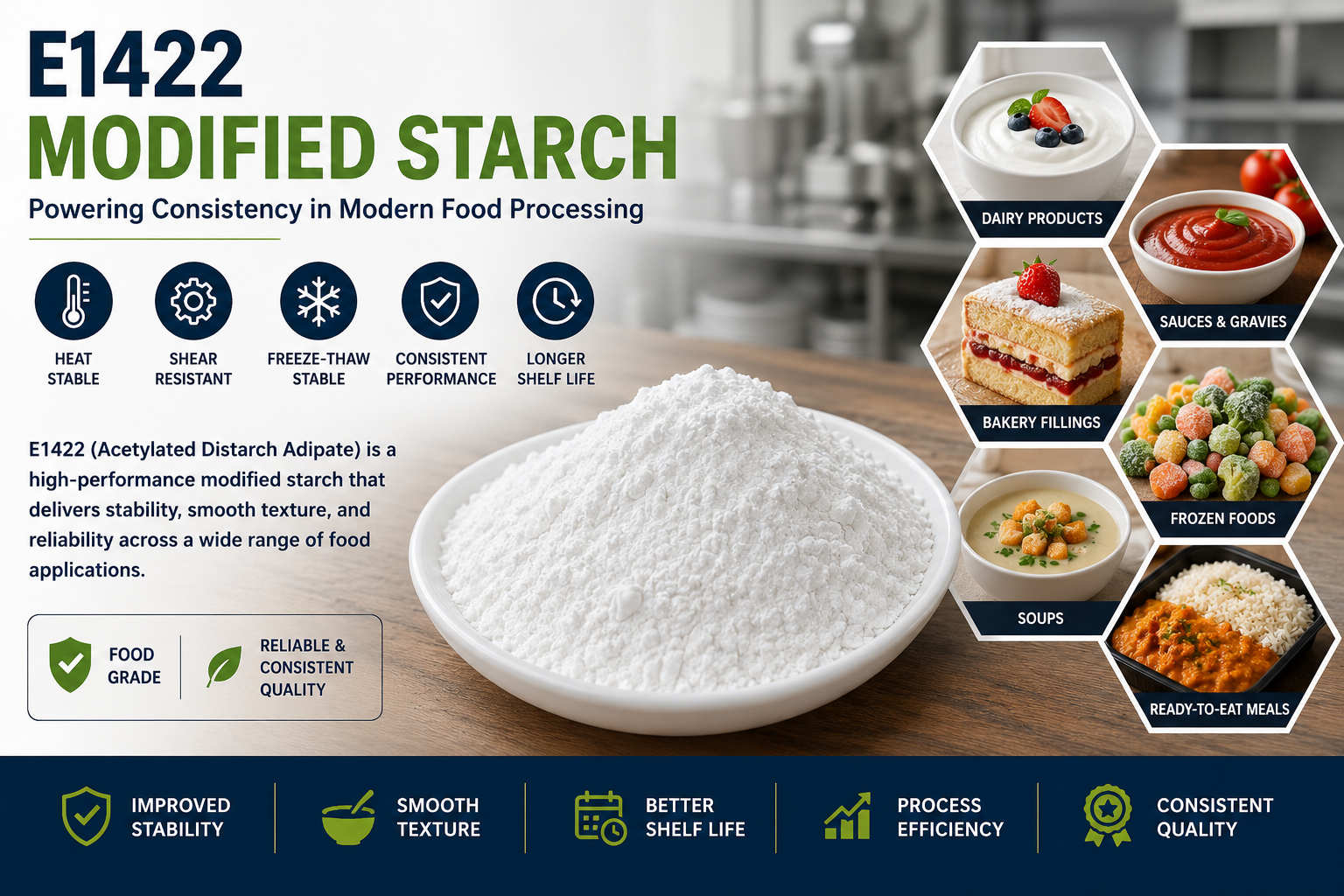
Also known as Acetylated Distarch Adipate, E1422 is a modified food starch designed to perform better than native starch under conditions such as high heat, mechanical shear, freezing, and thawing. Its improved functionality makes it a preferred choice across various food applications where product consistency and processing efficiency are essential.
In this blog, we’ll explore why food manufacturers rely on E1422 starch, its functional advantages, and the industries where it is commonly used.
What is E1422 Modified Starch?
E1422 modified starch, scientifically known as Acetylated Distarch Adipate, is a food-grade modified starch produced by treating natural starches such as corn, potato, or tapioca through approved food processing techniques. These modifications enhance the starch’s physical and functional properties without changing its role as a carbohydrate ingredient.
Unlike native starch, which may lose viscosity or break down during intensive processing, E1422 is engineered to provide improved stability and consistent performance under a wide range of manufacturing conditions.
Why Modern Food Processing Requires Modified Starch?
Today’s food manufacturing processes involve more than simple cooking. Products are often exposed to:
-
- High cooking temperatures
-
- Mechanical mixing and homogenisation
-
- Freezing and thawing cycles
-
- Acidic formulations
-
- Extended storage periods
Native starches may not consistently maintain their structure under these conditions. Modified starches such as E1422 help manufacturers maintain product quality from production through distribution and consumption.
Why Food Manufacturers Choose E1422 Modified Starch?
1. Excellent Heat Stability
Many processed foods undergo high-temperature cooking or sterilisation. E1422 modified starch maintains its thickening ability during these processes, helping products retain their intended texture even after prolonged heating.
2. Improved Shear Resistance
Food manufacturing often involves high-speed mixing, pumping, and homogenisation. E1422 performs well under these mechanical stresses, reducing the risk of viscosity loss during production.
3. Superior Freeze-Thaw Stability
Frozen foods experience repeated freezing and thawing during storage and transportation. One of the major benefits of E1422 modified starch is its ability to minimise water separation, helping preserve the texture and appearance of frozen products.
4. Consistent Product Texture
Consumers expect sauces to pour smoothly, yoghurt to remain creamy, and fillings to stay uniform. E1422 helps manufacturers deliver a consistent eating experience across production batches.
5. Better Shelf-Life Performance
Product quality should remain stable throughout its intended shelf life. E1422 contributes to maintaining viscosity, appearance, and texture over time, supporting overall product stability.
Key Functional Benefits of E1422 Modified Starch
| Functional Property | Benefit for Food Manufacturers |
| Heat stability | Maintains viscosity during cooking and processing |
| Shear stability | Performs well during mixing and homogenisation |
| Freeze-thaw stability | Reduces syneresis and texture degradation |
| Thickening capability | Delivers smooth, uniform consistency |
| Product stability | Helps maintain quality throughout shelf life |
| Process reliability | Supports consistent manufacturing performance |
Common Uses of E1422 Starch in Food Products
The uses of E1422 starch extend across numerous food categories due to its versatile functional properties.
| Food Category | Purpose |
| Dairy products | Improves creaminess and stability |
| Sauces and gravies | Maintains viscosity and smooth texture |
| Bakery fillings | Prevents separation and enhances consistency |
| Frozen foods | Improves freeze-thaw performance |
| Ready-to-eat meals | Maintains product structure during reheating |
| Soups | Provides consistent thickness |
| Dressings | Enhances stability and mouthfeel |
| Convenience foods | Supports processing efficiency and product quality |
E1422 Modified Starch vs Native Starch
Understanding the differences between native starch and modified starch helps explain why manufacturers often choose E1422 for demanding food applications.
| Feature | Native Starch | E1422 Modified Starch |
| Heat resistance | Moderate | Excellent |
| Shear stability | Limited | High |
| Freeze-thaw performance | Lower | Superior |
| Shelf-life stability | Moderate | Improved |
| Processing consistency | Variable | Reliable |
Industries That Commonly Use E1422
Several sectors within the food industry benefit from the functional performance of Acetylated Distarch Adipate, including:
-
- Dairy manufacturing
-
- Processed food production
-
- Frozen food manufacturing
-
- Bakery and confectionery
-
- Sauce and condiment production
-
- Convenience food manufacturing
-
- Ready-to-cook meal production
Its versatility allows formulators to develop products that meet both processing requirements and consumer expectations.
Factors Manufacturers Consider When Selecting Modified Starch
Selecting the right modified starch depends on several formulation and processing requirements, including:
-
- Processing temperature
-
- Product pH
-
- Desired viscosity
-
- Freeze-thaw requirements
-
- Shelf-life expectations
-
- Final product texture
-
- Manufacturing process conditions
By evaluating these factors, manufacturers can choose a starch that aligns with their specific application needs.
The Growing Role of Modified Starches in Food Innovation
As food manufacturers continue to develop products with improved convenience, longer shelf life, and enhanced sensory appeal, functional ingredients like E1422 modified starch have become increasingly important.
From frozen meals and dairy products to bakery applications and ready-to-eat foods, modified starches help manufacturers meet evolving consumer expectations while supporting efficient production processes.
With ongoing innovation in food formulation and processing technologies, ingredients that provide reliable functionality are expected to remain an essential part of modern food manufacturing.
Final Thoughts
Modern food processing demands ingredients that perform consistently under challenging manufacturing conditions. E1422 modified starch has become a preferred choice because it delivers reliable thickening, improved stability, better texture, and enhanced resistance to heat, shear, and freeze-thaw cycles.
Understanding the functional properties and applications of E1422 starch enables food manufacturers to make informed formulation decisions that support product quality and production efficiency. As demand for high-quality processed foods continues to grow, modified starches such as acetylated distarch adipate will remain valuable ingredients in the development of stable, consistent, and consumer-friendly food products.
Looking for a reliable E1422 modified starch supplier?
Whether you’re developing new food formulations or optimising existing products, Premier Starch offers high-quality modified starch solutions backed by technical expertise and consistent product performance. Contact Premier Starch today to discuss your E1422 modified starch requirements and find the right solution for your food processing needs.