In industries like packaging, textiles, films, and thermocouple manufacturing, paper tubes and cores are expected to perform under constant stress compression, humidity, high-speed winding, and load-bearing conditions. The choice of adhesive binder plays a decisive role in how these tubes hold up over time.
This is where the comparison between traditional corn starch and advanced dextrin based solutions becomes critical, especially when manufacturers are shifting toward high-performance materials such as dextrin for paper tube core and modified starch adhesives for paper tube core.
Understanding the Role of Starch-Based Adhesives in Paper Tube Manufacturing
Paper tubes are manufactured by winding layers of paper bonded together with adhesives. These adhesives must deliver:
- High bond strength
- Fast setting time
- Resistance to moisture and heat
- Consistency during high-speed production
Traditional corn starch has been widely used due to its availability and cost-effectiveness. However, with increasing production speeds and performance expectations, its limitations are becoming more apparent.
What Makes Advanced Dextrin Starch Different?
Dextrins are modified starch derivatives processed to enhance adhesion, solubility, and drying characteristics. Compared to native corn starch, dextrins offer improved functionality tailored for industrial applications.
Key advantages include:
- Better solubility in water
- Faster drying and setting times
- Stronger bonding properties
- Improved machinability in automated plants
These properties make dextrin-based adhesives particularly suitable for demanding applications like spiral paper tubes and high load cores. At Premier Starch, solutions like Stardex® 2155-Tube are specifically designed for paper core applications, offering enhanced strength and faster processing efficiency.
Stress Testing Parameters: What Really Matters
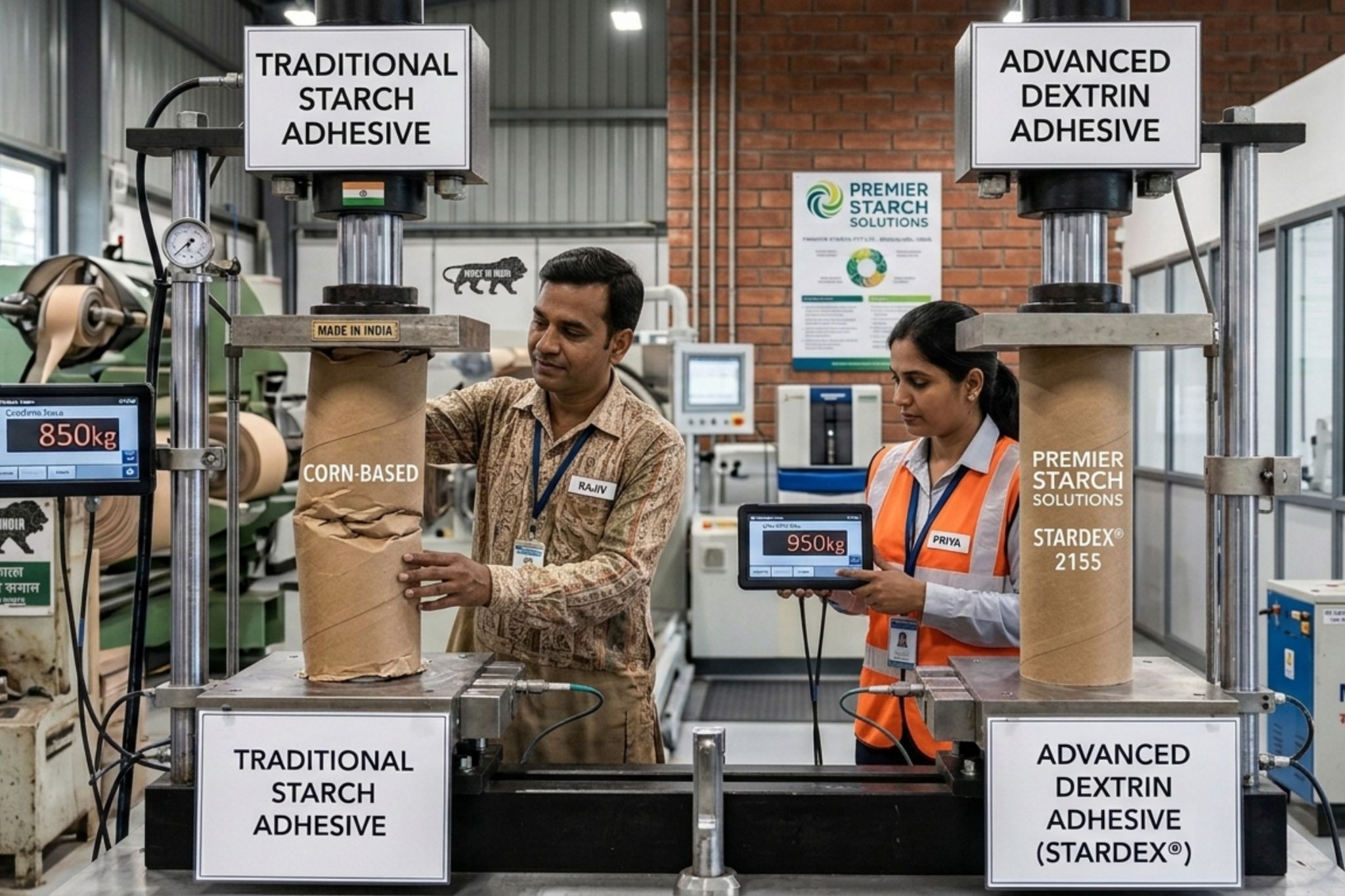
To evaluate performance, paper tubes bonded with both adhesive types are tested under real world stress conditions:
1. Compression Strength
Paper tubes must withstand vertical loads during stacking and transportation.
- Corn starch adhesives often show moderate compression resistance
- Dextrin-based adhesives provide significantly higher structural integrity
2. Adhesion Strength
Bonding between paper layers is critical for durability
- Traditional starch may weaken under variable humidity
- Dextrin adhesives maintain consistent bonding across environments
3. Moisture Resistance
Exposure to humidity can degrade adhesive performance
- Corn starch tends to absorb moisture, leading to reduced strength
- Dextrins exhibit better resistance and stability
4. Drying Time and Production Efficiency
In high-speed manufacturing, faster drying means higher output
- Corn starch requires longer drying cycles
- Dextrin solutions enable quicker processing and reduced downtime
5. Surface Finish and Consistency
Uniform application ensures defect free tubes
- Dextrin adhesives provide smoother application and fewer inconsistencies
Performance Comparison: Dextrin vs Corn Starch
| Parameter | Corn Starch Adhesive | Advanced Dextrin Adhesive |
| Bond Strength | Moderate | High |
| Drying Speed | Slow | Fast |
| Moisture Resistance | Low | High |
| Production Efficiency | Limited | Optimised |
| Consistency | Variable | Stable |
The results clearly indicate that dextrin based solutions outperform traditional starch in nearly all critical areas.
Why Manufacturers Are Shifting to Dextrin-Based Solutions?
Modern industrial environments demand precision, speed, and reliability. Dextrin adhesives address these needs effectively by:
- Supporting high-speed winding machines
- Reducing rejection rates
- Improving end-product durability
- Enhancing overall plant efficiency
For industries where downtime and defects translate directly into losses, upgrading adhesive systems is no longer optional it’s strategic.
Application-Specific Advantages in Paper Tube Cores
Advanced dextrin formulations are particularly beneficial in:
- Textile yarn cores requiring high compression strength
- Film and foil winding cores needing smooth finishes
- Thermocouple tubes requiring dimensional stability
These use cases highlight why modified starch adhesives for paper tube core are increasingly preferred over conventional options.
Sustainability Angle: A Growing Priority
Beyond performance, dextrin-based adhesives align with sustainability goals. Being derived from plant-based sources, they offer:
- Biodegradability
- Reduced reliance on synthetic chemicals
- Cleaner production processes
This makes them a future-ready solution for manufacturers aiming to meet environmental standards.
Conclusion
Stress testing clearly demonstrates that advanced dextrin starch adhesives deliver superior performance compared to traditional corn starch in paper tube manufacturing. From higher strength and faster drying to better moisture resistance, dextrins offer a well rounded solution for modern industrial demands.
As production environments continue to evolve, the shift toward high-performance adhesive systems like dextrin for paper tube core is becoming a necessity rather than a choice.
Why Choose Premier Starch for High-Performance Adhesives?
Premier Starch Products Pvt. Ltd. brings a deep understanding of industrial adhesive requirements across paper tubes, corrugation, and specialty applications. Their advanced dextrin formulations are engineered through in house R&D and rigorous quality control to ensure consistent batch performance and reliable results on the production floor.
Whether you are scaling operations or optimising existing processes, Premier Starch delivers tailored solutions designed to meet your exact manufacturing needs with precision and consistency.