Industrial manufacturing depends heavily on raw materials that deliver consistency, process stability, and reliable performance. In sectors such as foundry chemicals and abrasive manufacturing, even minor variations in binder quality can affect production efficiency, product strength, and overall output quality.
This is where dextrins have established themselves as valuable industrial ingredients. Derived from natural starch sources through controlled processing, dextrins offer excellent binding properties, controlled viscosity, and dependable performance across multiple industrial applications. Today, products such as maize yellow dextrin for foundry chemicals and dextrin for coated abrasives continue to play a critical role in helping manufacturers maintain quality while improving operational efficiency.
Understanding Dextrins and Their Industrial Importance
Dextrins are low-molecular-weight carbohydrates produced by the controlled heating and modification of starch. Depending on the raw material source and manufacturing process, different grades of dextrins can be developed to meet specific industrial requirements.
Industries prefer dextrins because they offer:
- Excellent binding strength
- Good film-forming properties
- Controlled viscosity
- Improved adhesion
- Ease of application
- Cost-effective performance
- Environmentally friendly and biodegradable characteristics
These advantages make dextrins suitable for a wide range of industrial formulations where strength, consistency, and processing efficiency are essential.
Why Dextrins Are Widely Used in Foundry Resin Chemicals?
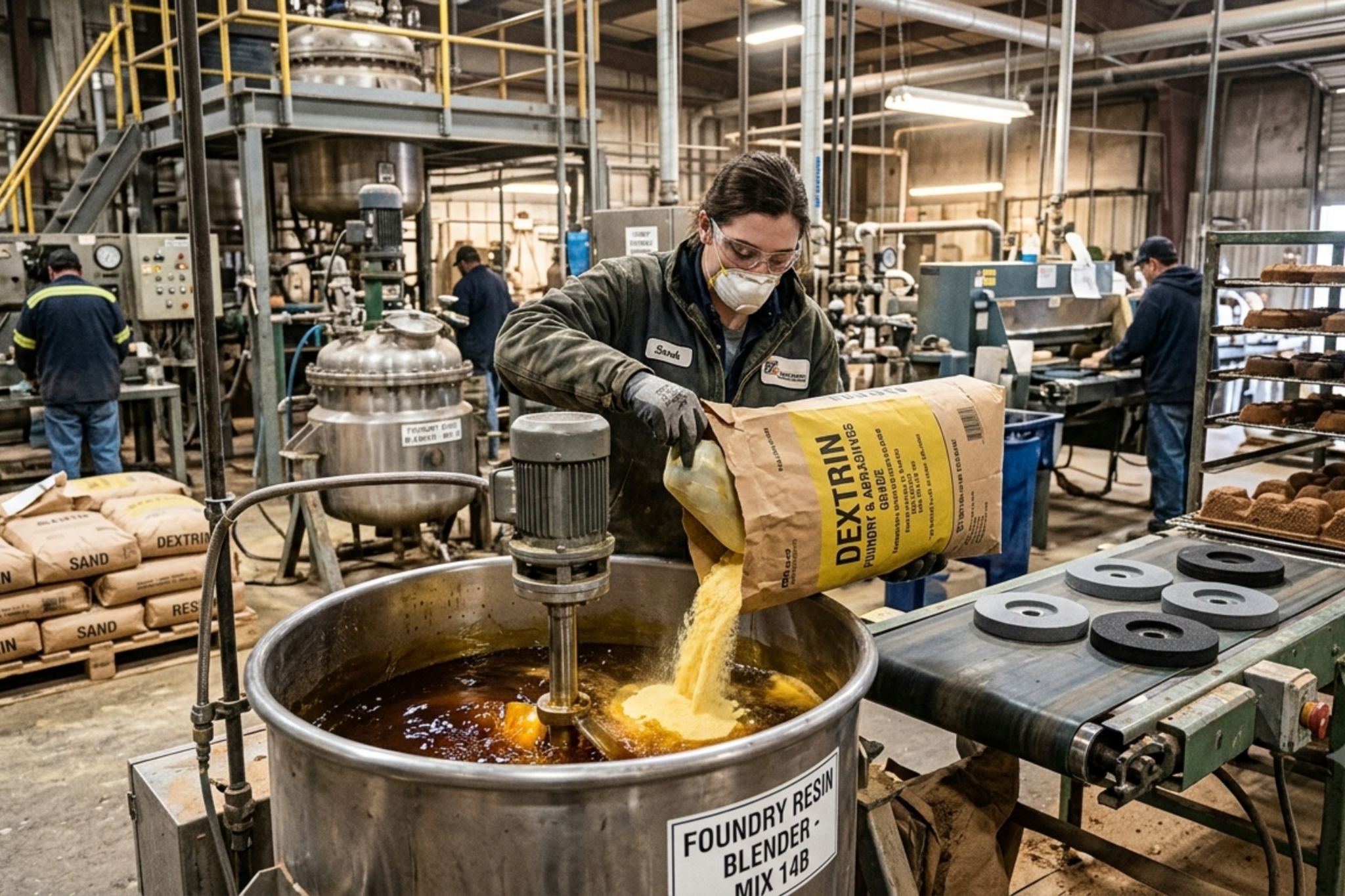
The foundry industry requires materials that can withstand demanding manufacturing conditions while maintaining dimensional accuracy and mould integrity. Dextrins are commonly incorporated into foundry resin chemical formulations to improve the performance of moulding and core-making systems.
Key Functions of Dextrins in Foundry Applications
| Function | Benefit |
| Binding Agent | Improves mould cohesion and strength |
| Green Strength Enhancement | Helps moulds retain shape before curing |
| Surface Finish Improvement | Produces smoother castings |
| Process Stability | Supports consistent production quality |
| Controlled Burn-Out | Reduces defects during metal casting |
Among various grades available, maize yellow dextrin for foundry chemicals is widely preferred because of its excellent binding characteristics and dependable performance in moulding applications.
Manufacturers often require dextrins that provide stable performance from batch to batch. This consistency helps reduce casting defects, improve mould strength, and support efficient production cycles.
For foundry chemical manufacturers seeking reliable performance, products such as Stardex® 2155 Maize Yellow can provide the binding strength and process stability required for demanding foundry operations.
The Growing Role of Dextrin for Coated Abrasives
The abrasive industry operates under equally demanding conditions. Coated abrasives must maintain strong adhesion between abrasive grains and backing materials while withstanding mechanical stress during use.
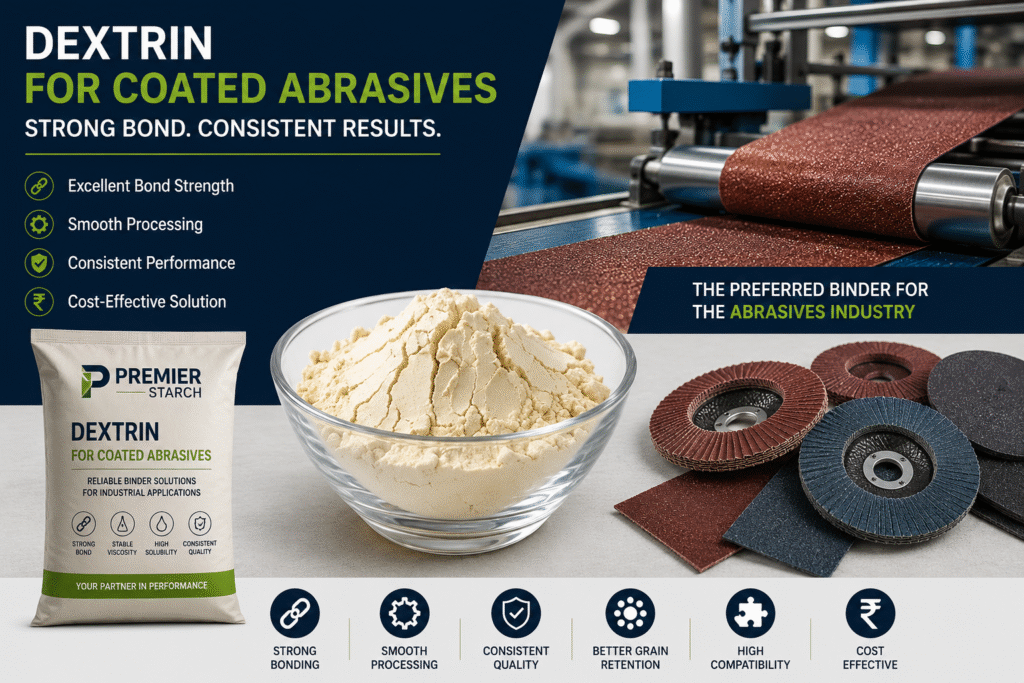
This is where dextrin for coated abrasives becomes an essential component in abrasive manufacturing formulations.
How Dextrins Support Abrasive Manufacturing
Dextrins contribute to abrasive production by:
- Improving grain adhesion
- Enhancing coating uniformity
- Supporting binder performance
- Increasing production consistency
- Improving finished product durability
In coated abrasive manufacturing, achieving uniform grain distribution is critical. Poor binder performance can lead to uneven coatings, reduced abrasive life, and inconsistent product quality.
By incorporating specially developed dextrin grades, manufacturers can achieve stronger bonding between abrasive particles and backing materials, resulting in improved product performance.
Benefits of Using Dextrins in Coated Abrasives
| Performance Area | Benefit |
| Adhesion Strength | Better grain retention |
| Coating Quality | More uniform abrasive layers |
| Process Efficiency | Reduced manufacturing variations |
| Product Durability | Longer service life |
| Production Consistency | Reliable batch-to-batch performance |
Industrial manufacturers often select specialised dextrin grades developed specifically for abrasive applications. Products such as Stardex® 2155-GNL for coated abrasives are formulated to deliver the performance characteristics required by modern abrasive production facilities.
What Manufacturers Look for in Industrial Dextrins?
Selecting the right dextrin grade involves more than simply choosing a binder. Manufacturers typically evaluate several performance factors before finalising their formulation.
Important Selection Criteria
- Consistent viscosity
- Controlled moisture content
- Stable pH levels
- Solubility characteristics
- Adhesion performance
- Compatibility with existing processes
- Reliable supply availability
These factors directly influence production efficiency, product quality, and operational costs.
Sustainability Advantages of Starch-Based Dextrins
As industries continue moving toward sustainable manufacturing practices, dextrins offer a practical alternative to many synthetic binders.
Because dextrins are derived from renewable starch sources, they provide several environmental benefits:
- Biodegradable composition
- Reduced dependence on petroleum-based materials
- Lower environmental impact
- Support for sustainable manufacturing goals
This combination of performance and sustainability makes dextrins increasingly attractive across multiple industrial sectors.
Conclusion
From improving mould strength in foundries to enhancing grain adhesion in abrasive manufacturing, dextrins continue to play a vital role in industrial production. Their ability to provide reliable binding performance, process consistency, and sustainable benefits makes them a preferred choice for manufacturers seeking dependable raw material solutions.
Whether the application requires maize yellow dextrin for foundry chemicals or specialised dextrin for coated abrasives, selecting the right grade can significantly improve production efficiency and final product performance.
Why Industries Choose Premier Starch?
With more than three decades of manufacturing expertise, Premier Starch has developed specialised dextrin solutions tailored to the needs of foundry, abrasive, mining, paint, paper tube, and adhesive industries. Supported by in-house research, stringent quality testing, and application-focused product development, the company delivers starch-based solutions designed to help manufacturers achieve greater consistency, stronger performance, and dependable production outcomes across demanding industrial environments.