In corrugated box manufacturing, adhesive performance plays a direct role in production speed, board strength, machine efficiency, and overall product quality. While machinery and paper quality often receive most of the attention, the adhesive system can significantly influence the consistency of the entire operation.
Among the most widely used adhesive solutions in the corrugation industry are cold & hot pasting gum powder products. Both are designed to bond paper layers effectively, but they differ in preparation methods, application processes, production environments, and performance characteristics.
Understanding these differences can help manufacturers select the right adhesive for their plant operations and achieve better productivity with fewer process interruptions.
Understanding Corrugation Gum Powder
Corrugation gum powder is a starch-based adhesive formulation developed specifically for corrugated box production. These powders are engineered to provide reliable bonding between liner and fluting papers while maintaining consistent viscosity, solid content, and drying characteristics.
Depending on plant requirements and production setups, manufacturers typically choose between cold pasting and hot pasting adhesive systems.
What Is Cold Pasting Gum Powder?
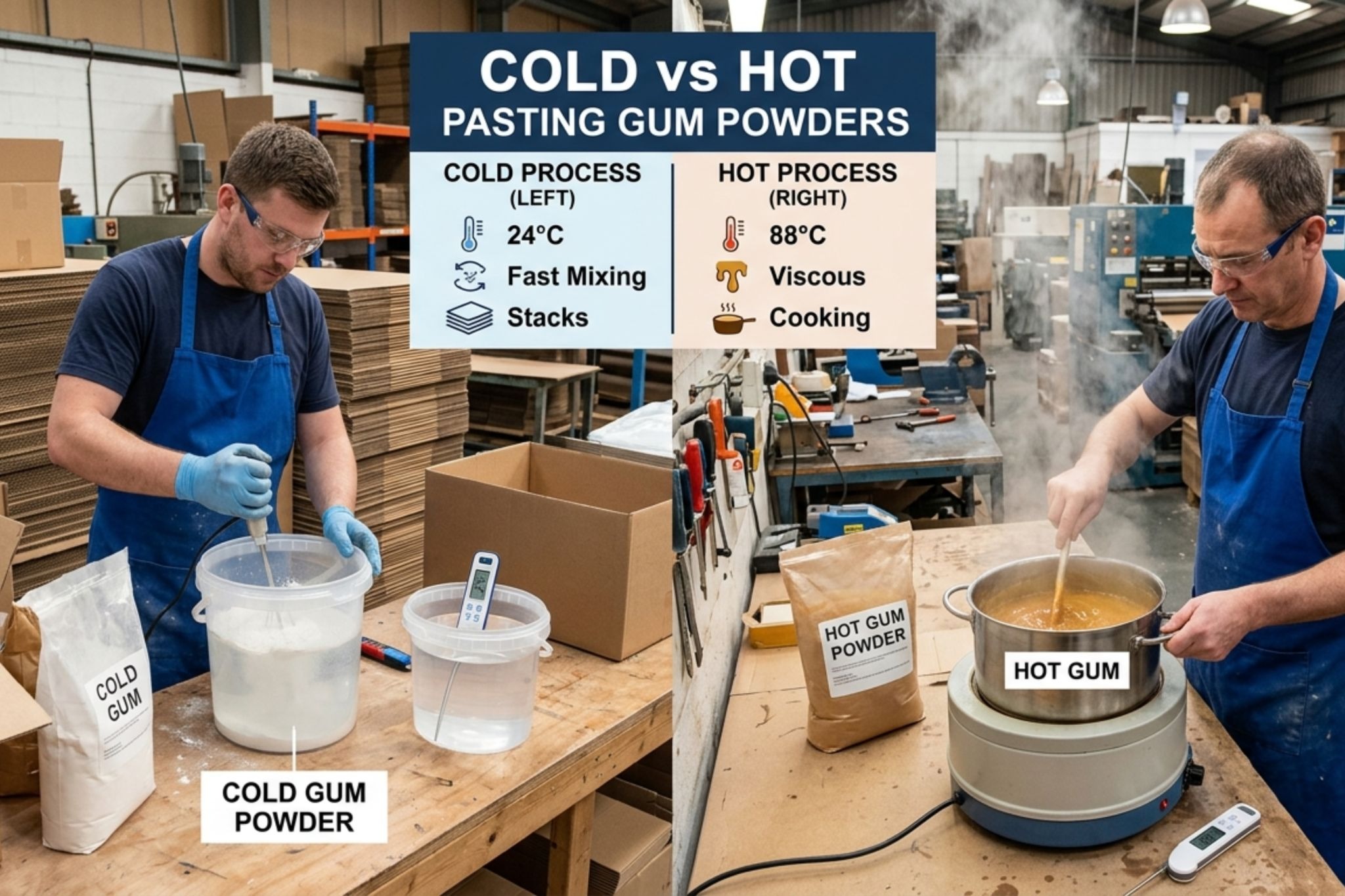
Cold pasting gum powder is designed to dissolve and develop adhesive properties without requiring heat during preparation. The adhesive can be prepared using water at ambient temperatures, making it convenient for many corrugation plants.
This type of adhesive is commonly used in:
- Manual corrugation units
- Semi-automatic corrugation plants
- Small to medium production facilities
- Operations seeking faster adhesive preparation
Advantages of Cold Pasting Gum Powder
- Simple preparation process
- Lower energy consumption
- Faster adhesive preparation
- Reduced equipment requirements
- Consistent bonding performance for standard production speeds
Many manufacturers prefer cold pasting systems because they reduce operational complexity while maintaining reliable board bonding.
For manual and semi-automatic operations, products such as Stargel® TS and Stargel® 1120 are specifically developed to provide dependable adhesion and smooth machine performance.
What Is Hot Pasting Gum Powder?
Hot pasting gum powder requires heating during adhesive preparation to activate starch components and achieve the desired viscosity and bonding characteristics.
These formulations are generally preferred in:
- High-volume production facilities
- High-speed corrugation plants
- Applications requiring stronger bond development
- Operations demanding enhanced moisture resistance
Advantages of Hot Pasting Gum Powder
- Strong bond formation
- Improved penetration into paper fibres
- Suitable for high-speed production
- Better performance under demanding manufacturing conditions
- Consistent adhesive strength across large production runs
Manufacturers operating larger corrugation facilities often select hot pasting systems to support faster machine speeds and maintain board quality.
Products such as Stardex® 840 Hot Pasting Gum Powder are formulated specifically for these demanding corrugation environments.
Cold vs Hot Pasting Gum Powder: Key Differences
| Feature | Cold Pasting Gum Powder | Hot Pasting Gum Powder |
| Preparation Method | Mixed with water at room temperature | Requires heating during preparation |
| Energy Consumption | Lower | Higher |
| Preparation Time | Faster | Slightly longer |
| Equipment Requirement | Minimal | Heating equipment required |
| Production Scale | Manual & Semi-Automatic Plants | High-Speed Automatic Plants |
| Bond Strength | Good | Higher |
| Process Complexity | Simple | Moderate |
While both systems perform effectively, the best choice depends on production requirements rather than one product being universally better than the other.
Factors to Consider Before Choosing
1. Plant Type
The type of corrugation plant is often the first deciding factor.
- Manual plants generally benefit from cold pasting systems.
- Semi-automatic plants commonly use cold pasting adhesives for ease of operation.
- Fully automatic and high-speed plants may achieve better results with hot pasting formulations.
2. Production Volume
Higher production volumes place greater demands on adhesive consistency and bonding performance.
For large-scale operations, hot pasting systems often provide additional process stability.
3. Energy Costs
Cold pasting adhesives eliminate heating requirements, helping reduce energy consumption and operating expenses.
4. Required Bond Strength
Applications involving heavier board grades or demanding packaging requirements may benefit from stronger hot-pasting adhesive systems.
5. Operational Simplicity
Plants seeking quick preparation and simplified adhesive handling often prefer cold pasting solutions.
Common Challenges and How the Right Adhesive Helps
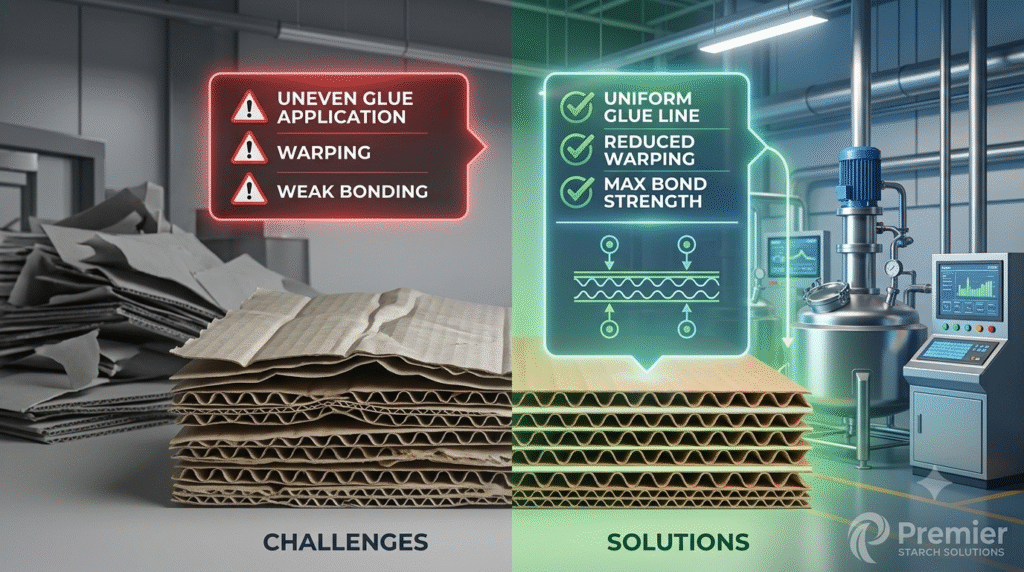
Corrugated box manufacturers frequently encounter challenges such as:
- Delamination
- Weak pin adhesion
- Excessive adhesive consumption
- Inconsistent viscosity
- Slow drying times
- Machine downtime
Selecting the appropriate adhesive system and maintaining proper viscosity control can help address these issues while improving production efficiency.
This is why many manufacturers work closely with suppliers that provide not only products but also formulation guidance and technical support for plant-specific requirements.
Why Consistency Matters More Than Price?
While adhesive cost is an important consideration, long-term performance often has a greater impact on overall production economics.
A well-formulated starch adhesive can help:
- Reduce board rejection rates
- Improve machine uptime
- Enhance bond reliability
- Minimise process variations
- Lower overall production costs
The right adhesive solution should support consistent manufacturing performance rather than simply offering the lowest purchase price.
Conclusion
Both cold and hot pasting gum powders serve important roles in corrugated box manufacturing. Cold pasting systems offer simplicity, lower energy consumption, and ease of handling, making them ideal for manual and semi-automatic plants. Hot pasting systems provide enhanced bonding strength and are better suited for high-speed industrial operations.
The best choice ultimately depends on your plant configuration, production capacity, board specifications, and operational goals. Evaluating these factors carefully can help ensure better productivity, stronger box performance, and more reliable manufacturing outcomes.
Partner with Premier Starch for Reliable Corrugation Adhesive Solutions
For more than three decades, Premier Starch Products Pvt. Ltd. has supported corrugated packaging manufacturers with performance-driven starch adhesive technologies. From cold-pasting formulations for manual operations to specialised hot-pasting solutions for high-speed production lines, our products are developed to deliver consistent viscosity, dependable bonding, and stable performance across varying plant conditions.
With in-house R&D, batch wise quality control, and technical assistance for plant trials, Premier Starch helps manufacturers optimise adhesive performance and improve production efficiency with confidence.